Is the High Output 6.7L Power Stroke Worth It for Farm Towing in Pennsylvania?
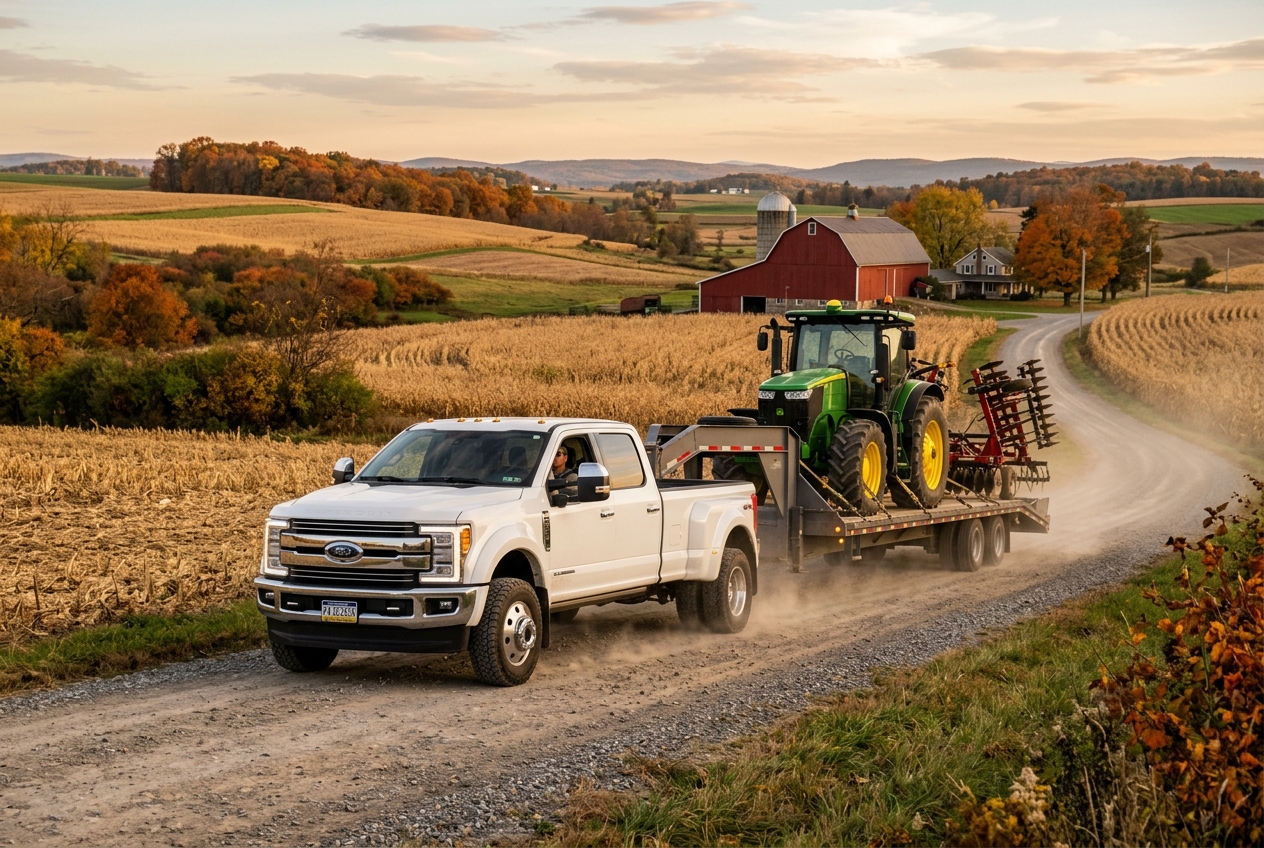
For Pennsylvania farmers and agricultural businesses, choosing between Ford’s standard and High Output 6.7-liter Power Stroke diesel engines is not simply a matter of buying the engine with the largest torque number. The right choice depends on the trailer, loaded weight, towing frequency, terrain, required payload, truck configuration, and the financial value of additional capability.
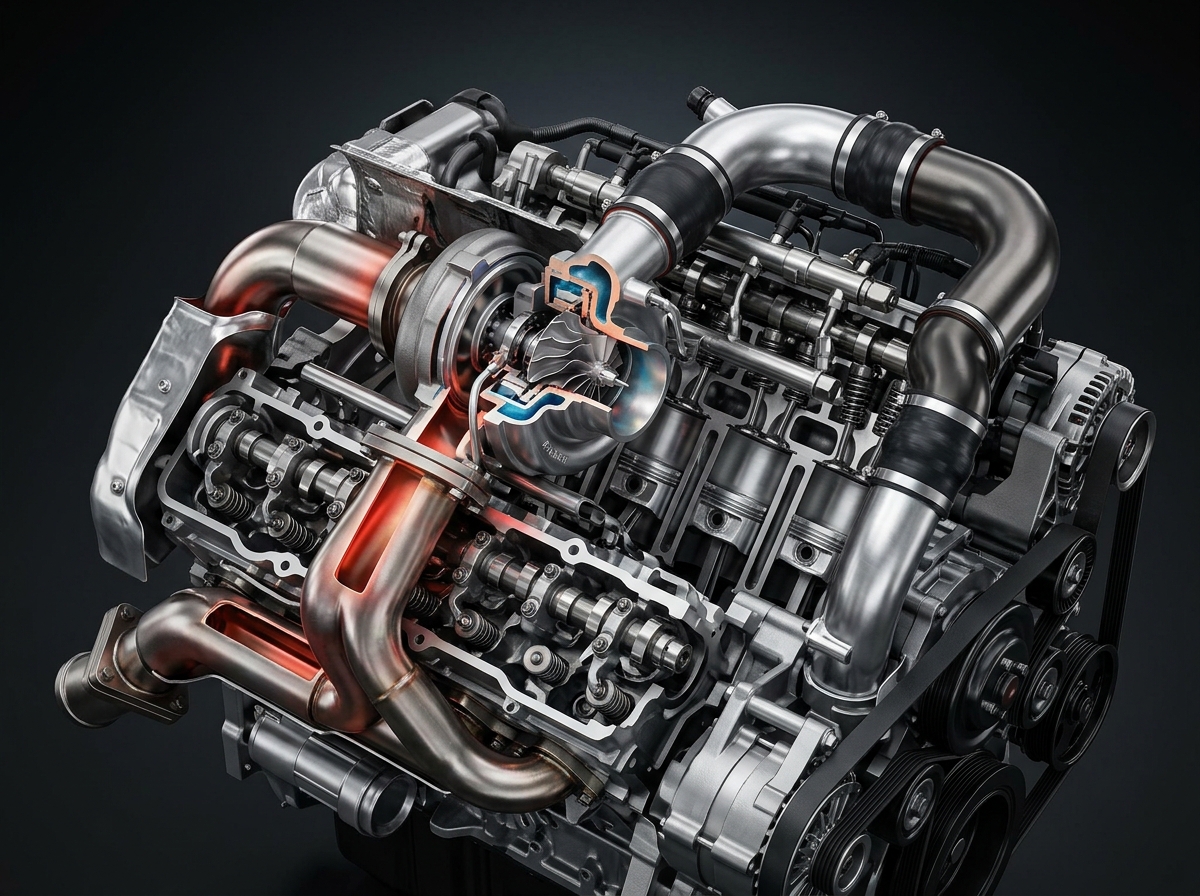
The High Output 6.7-liter Power Stroke produces 500 horsepower and 1,200 pound-feet of torque. The standard 6.7-liter Power Stroke produces 475 horsepower and 1,050 pound-feet of torque. Both are paired with a TorqShift ten-speed automatic transmission.
The High Output engine can be worth the investment for farms that frequently move large livestock trailers, loaded goosenecks, heavy implements, or other substantial loads across the rolling terrain of Berks, Schuylkill, Lehigh, and surrounding Pennsylvania counties. Farms towing less frequently—or operating well below the truck’s limits—may be adequately served by the standard Power Stroke or one of Ford’s gas V8 engines.
Drivers can compare available work trucks through the commercial vehicle inventory at Twin Pine Ford of Hamburg.
Standard vs. High Output 6.7L Power Stroke
The standard Power Stroke already provides substantial low-speed torque for towing, hauling, highway travel, and commercial work. It should not be treated as an underpowered alternative.
The High Output version adds 25 horsepower and 150 pound-feet of torque. That additional output is most useful when accelerating with a heavy trailer, maintaining speed on grades, merging into traffic, or repeatedly operating near the truck’s rated capacity.
| Specification | Standard 6.7L Power Stroke | High Output 6.7L Power Stroke |
|---|---|---|
| Horsepower | 475 horsepower | 500 horsepower |
| Torque | 1,050 lb-ft | 1,200 lb-ft |
| Transmission | TorqShift 10-speed automatic | TorqShift 10-speed automatic |
| Best Fit | General farm work, equipment hauling and moderate-to-heavy towing | Frequent heavy towing, demanding grades and high combined weights |
| Primary Tradeoff | Lower initial engine cost | Higher purchase price for additional output |
Engine choice alone does not establish towing or payload capacity. The truck’s series, cab, bed, drivetrain, axle ratio, wheelbase, rear-wheel configuration, hitch equipment, passengers, and cargo all affect its final rating.
When Is the High Output Diesel Worth It?
The High Output Power Stroke makes the strongest business case when the truck regularly performs work that can use its additional output.
The High Output engine may be worthwhile when:
- The truck routinely pulls a heavily loaded gooseneck or fifth-wheel trailer.
- Routes include frequent grades, highway merging, or stop-and-go travel with a substantial load.
- Several heavy towing trips are completed during the same workday.
- Maintaining speed and responsiveness under load has a measurable productivity benefit.
- The farm plans to keep the truck long enough to justify the higher initial cost.
- The selected truck and trailer configuration can legally use the additional capability.
The standard Power Stroke may be the better value when:
- Heavy towing is occasional rather than routine.
- Most trips remain well below the truck’s rated towing capacity.
- The truck spends more time driving unloaded than pulling a trailer.
- Upfront cost is more important than maximum diesel output.
- Payload, hitch weight, or the truck’s gross vehicle weight rating becomes the limiting factor before engine power.
The brutal truth is that buying 1,200 pound-feet of torque does not fix an underspecified truck. If the cab, axle, tires, suspension, hitch, payload rating, or rear-wheel configuration is wrong, the High Output badge will not make the combination safe or legal.
F-250 vs. F-350 for Pennsylvania Farm Work
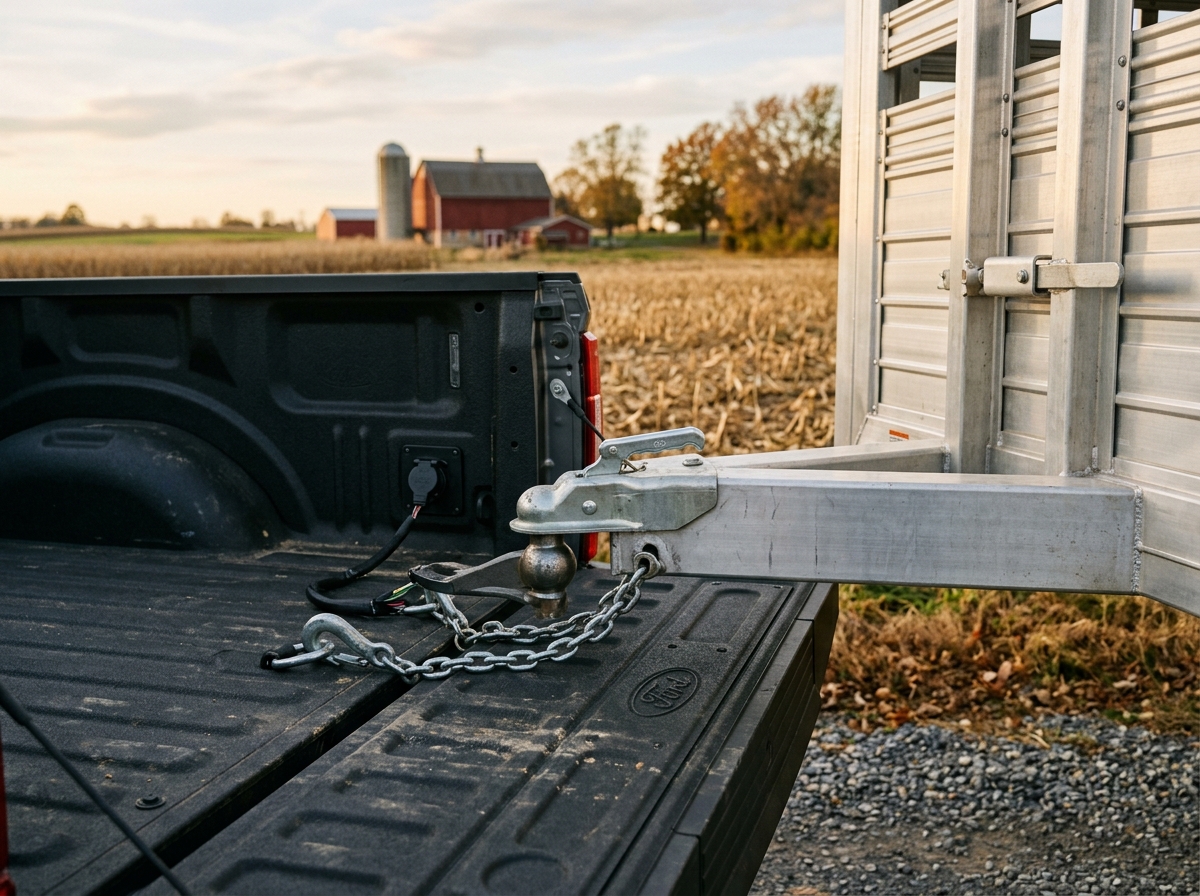
Ford F-250
The F-250 can be a strong fit for farms needing a heavy-duty pickup for tools, livestock supplies, smaller equipment trailers, hay, feed, and general property work.
It may provide a better balance for owners who need diesel torque but do not regularly require the higher available gross vehicle weight and payload ratings of an F-350.
Ford F-350
The F-350 offers higher available weight ratings and is available in single-rear-wheel and dual-rear-wheel configurations. It is generally the stronger candidate for heavier gooseneck pin weights, larger livestock trailers, auxiliary tanks, and substantial bed-mounted equipment.
A dual-rear-wheel F-350 can provide additional rear-axle capacity and stability, but it is wider and may be less convenient on narrow farm lanes or during everyday driving.
Do not select an F-250 or F-350 based only on an advertised maximum. Check the exact truck’s tire-and-loading label, certification label, payload rating, axle ratings, hitch limits, and Ford towing guide.
Understanding Super Duty Towing and Payload Ratings
The 2026 Ford Super Duty lineup offers a maximum available gooseneck towing rating of up to 40,000 pounds and a maximum available payload rating of up to 8,000 pounds. Those headline figures apply only to specific configurations and should not be interpreted as the rating of every F-250 or F-350.
The 40,000-pound maximum is achieved by a properly configured F-450—not a typical F-250 or F-350 farm truck. Buyers should be skeptical of any article or advertisement that quotes the lineup maximum without identifying the truck required to achieve it.
Key ratings to verify include:
- Gross Vehicle Weight Rating
- Gross Combined Weight Rating
- Front and rear Gross Axle Weight Ratings
- Vehicle-specific payload rating
- Conventional, fifth-wheel, or gooseneck tow rating
- Receiver, hitch, ball, coupler, and trailer ratings
- Tire load ratings
- Loaded trailer tongue or pin weight
The lowest-rated component determines the practical limit. A truck with enough engine power may still exceed its payload, rear-axle, tire, or hitch rating.
Farm Loads That Require Careful Configuration
Livestock Trailers
Livestock movement can affect trailer balance during travel. Confirm loaded trailer weight, pin or tongue weight, trailer-brake operation, tire condition, and weight distribution before departure.
Equipment and Implements
Tractors, skid steers, attachments, and other equipment can create concentrated loads. Positioning and securing the equipment correctly is just as important as staying below the maximum trailer rating.
Hay, Feed and Bulk Materials
Large loads can exceed payload or axle ratings before the truck appears visibly overloaded. Scales and verified weights are more reliable than visual estimates.
Mud, soft field entrances, gravel lanes, wet grass, and steep grades can reduce available traction. A four-wheel-drive truck may help the driver move a load, but it does not increase the truck’s certified payload or towing ratings.
What Fuel Economy Can You Expect?
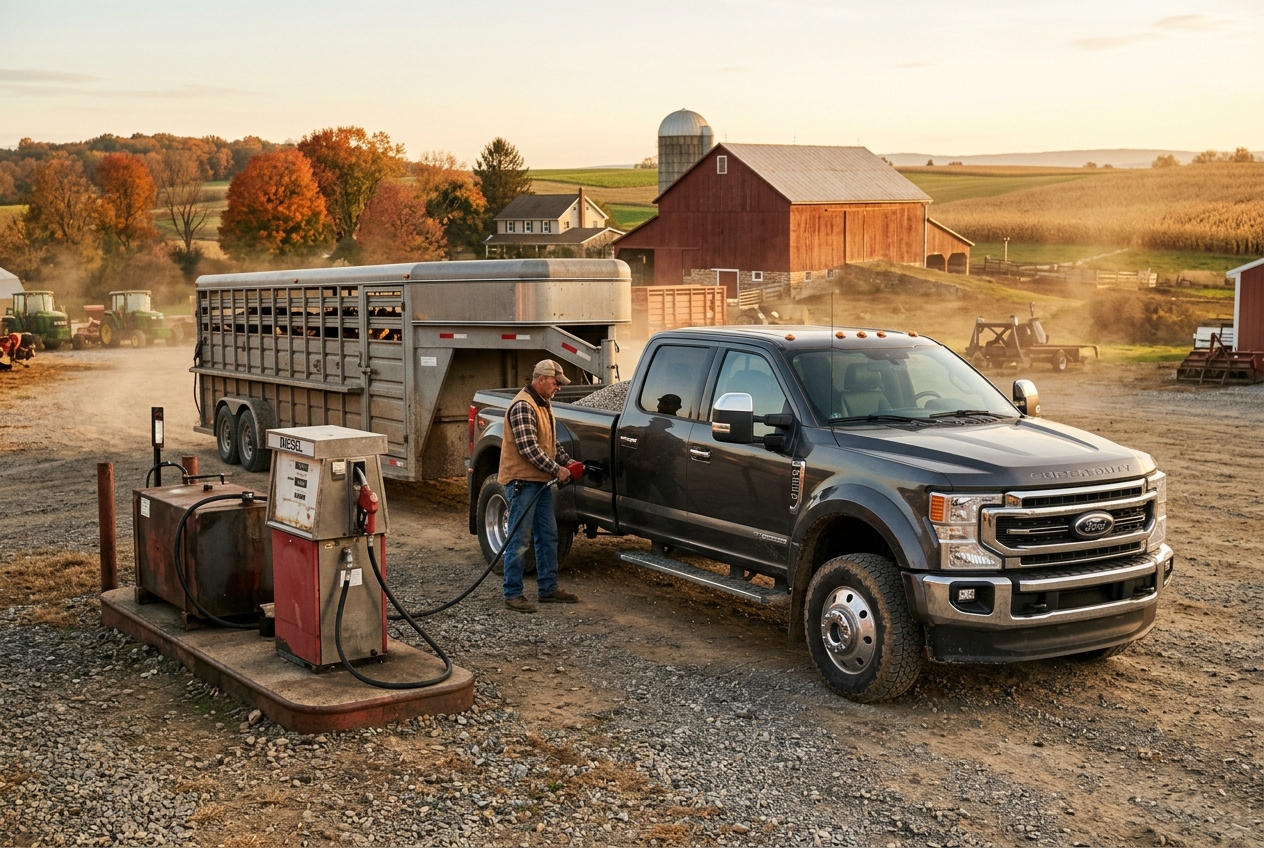
Heavy-duty pickups such as the F-250 and F-350 are generally not required to display the same EPA fuel-economy estimates as light-duty vehicles. Any universal MPG promise should therefore be treated cautiously.
Actual diesel consumption depends on:
- Truck and trailer weight
- Speed and acceleration
- Terrain and road conditions
- Wind and weather
- Idling time
- Tire type and pressure
- Axle ratio and drivetrain
- Diesel particulate filter regeneration
- Driver behavior
The High Output engine is not guaranteed to use less fuel than the standard diesel while towing. It may maintain speed with less downshifting in certain situations, but the additional output can also consume more fuel when used aggressively.
DEF and Regeneration
Both diesel engines use diesel exhaust fluid and an emissions system that includes a diesel particulate filter. DEF consumption and regeneration frequency vary with engine load, trip length, operating temperature, idle time, and driving conditions.
Repeated short trips and prolonged low-speed operation may not provide ideal conditions for passive regeneration. Follow the truck’s messages and owner’s manual rather than relying on a universal regeneration schedule.
Super Duty Towing Technology
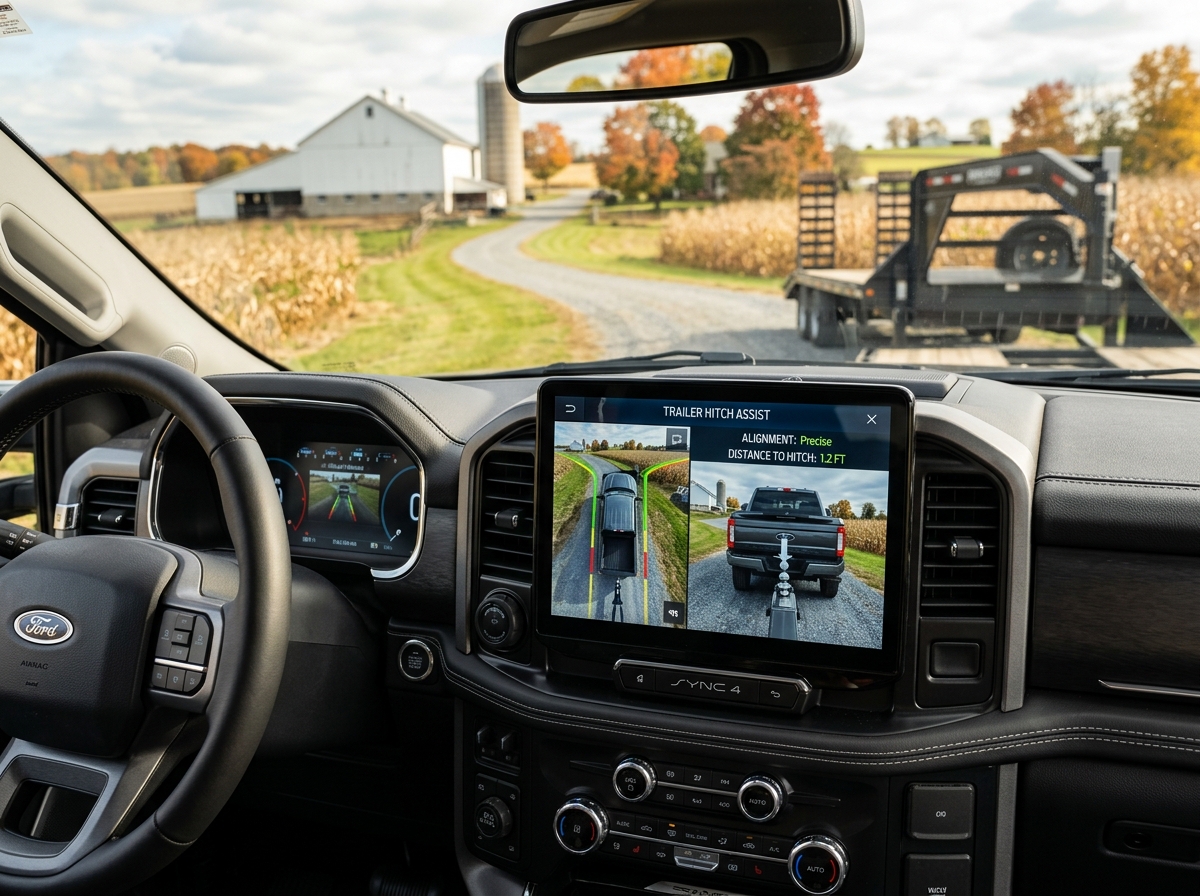
Depending on model and equipment, available Super Duty towing technologies can help drivers connect, monitor, and maneuver a trailer.
- Pro Trailer Hitch Assist: Can assist with steering, acceleration, and braking while backing toward a compatible conventional trailer coupler.
- Pro Trailer Backup Assist: Helps the driver direct a compatible trailer while reversing.
- Onboard Scales and Smart Hitch: Can provide estimated load and weight-distribution information on properly equipped trucks.
- 360-Degree Camera: Provides additional views around the truck while maneuvering.
- Integrated Trailer Brake Controller: Allows the driver to adjust compatible electric trailer-brake output.
- Trailer Sway Control: Can apply selective braking and reduce engine torque when trailer sway is detected.
- Diesel Exhaust Brake: Helps manage speed on descents and can reduce reliance on the service brakes.
These systems assist the driver but do not increase the truck’s ratings or replace correct loading, trailer maintenance, safe speed, and driver judgment.
Pennsylvania Farm-Vehicle Registration
Qualifying Pennsylvania agricultural operators may be eligible for farm-vehicle registration or, in limited situations, a farm-vehicle registration exemption. Eligibility and permitted use depend on the owner, agricultural operation, vehicle, weight, operating radius, and intended travel.
A truck bearing a Pennsylvania farm-vehicle registration plate is restricted to agricultural uses identified by Pennsylvania law. These can include travel on the farm, between farms operated by the registrant, and between the farm and certain places of business for purchasing or selling agricultural commodities or supplies.
Farm registration does not create a blanket exemption from weight, safety, licensing, insurance, inspection, or operating requirements. Certain heavier vehicles and classifications remain subject to additional rules.
Review the current PennDOT farm-vehicle requirements or speak with PennDOT before selecting a registration classification.
Maintenance for a Farm-Use Power Stroke
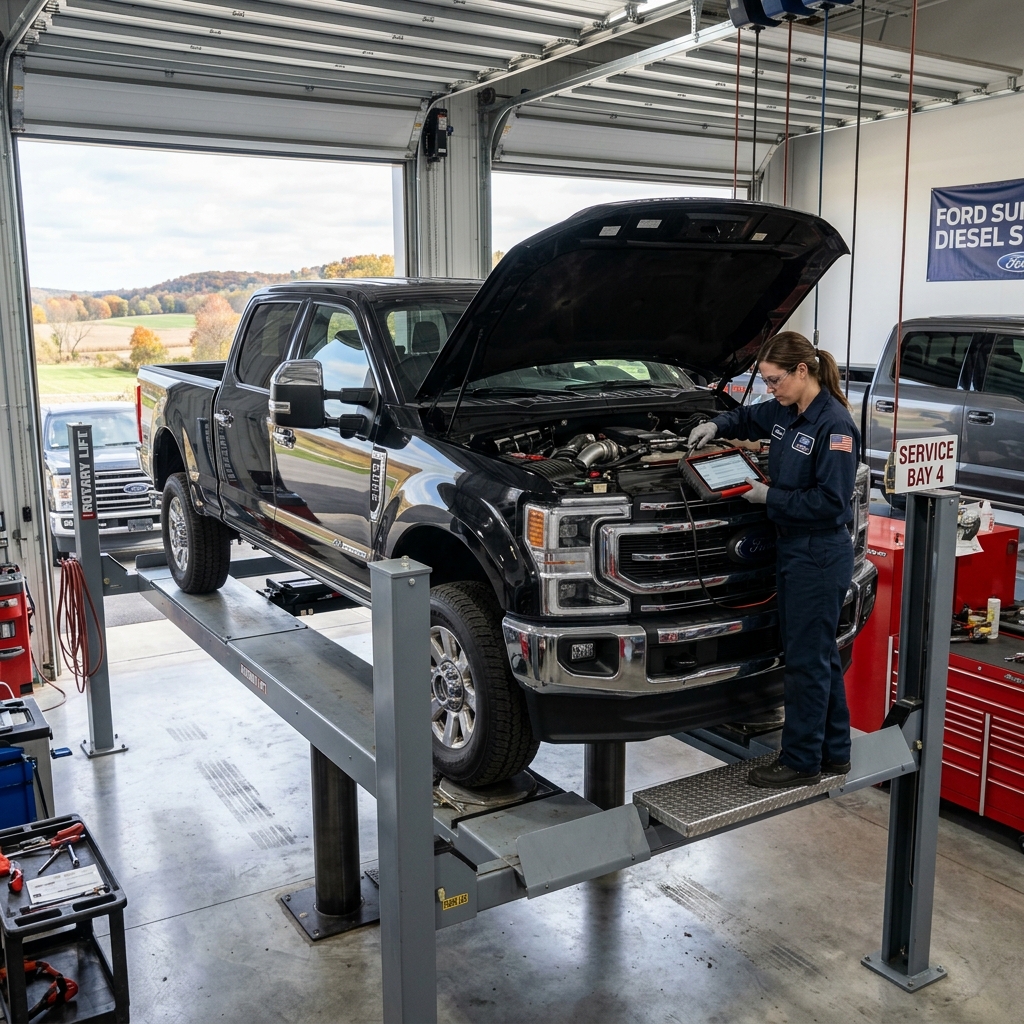
Follow the Oil-Life Monitor
Heavy towing, extended idling, dusty conditions, and short trips can affect oil life. Follow the Intelligent Oil-Life Monitor and the severe-use guidance in the truck’s owner’s manual.
Monitor Fuel and Water
Water or contamination in diesel fuel can damage high-pressure fuel-system components. Follow Ford’s procedures for the fuel-water separator and replace filters according to the vehicle’s current maintenance schedule.
Inspect Air Filtration
Dust, chaff, and debris can load an air filter more quickly. Inspect it more frequently during harvest, field, or other dusty operation and replace it when required.
Maintenance requirements vary with use and model year. Do not rely on a universal mileage interval taken from an unrelated truck or older owner’s manual.
The Twin Pine Commercial Vehicle Center services Ford vehicles and other makes, including heavy commercial vehicles, large RVs, school buses, and vehicles up to 18-wheeler size. Call the service team at (610) 685-0227 to discuss your vehicle and service needs.
Section 179 and Farm-Truck Tax Considerations
A Super Duty used in a qualifying agricultural business may be eligible for Section 179 expensing, depreciation, or other business-vehicle tax treatment. Eligibility is not determined solely by purchasing a truck with a gross vehicle weight rating above 6,000 pounds.
The available deduction can depend on:
- The percentage of qualified business use
- The date the truck is placed in service
- The truck’s body and configuration
- Total qualifying property purchased during the year
- Business taxable income
- Section 179 and depreciation limits
- Whether business use remains above the required threshold
Twin Pine Ford of Hamburg cannot determine a purchaser’s tax eligibility. Consult a qualified tax professional before purchasing a truck based on an anticipated deduction.
Financing and Trade-In Options
Farm and commercial customers can review available purchase options through the Twin Pine Ford of Hamburg Finance Center or begin with the online finance application.
Use the dealership’s Kelley Blue Book Instant Cash Offer tool to begin evaluating a current truck or fleet vehicle. Final value depends on equipment, condition, mileage, market demand, and an in-person inspection.
High Output Power Stroke FAQs
Does the High Output Power Stroke increase every truck’s towing capacity?
No. It provides additional engine output, but towing capacity still depends on the complete configuration. The engine does not override payload, axle, tire, hitch, GVWR, or GCWR limits.
Is the High Output diesel necessary for an F-350?
No. The standard 6.7-liter Power Stroke already produces 475 horsepower and 1,050 pound-feet of torque. The High Output engine is most valuable for owners who regularly use the additional performance.
Is an F-350 always better than an F-250 for farm work?
No. The F-350 generally offers higher available weight ratings, but an F-250 may provide all the capability a farm needs with a lower initial cost. The actual load should determine the truck.
Does a dual-rear-wheel truck tow more?
A dual-rear-wheel configuration generally provides greater rear-axle and payload capability and improved stability. Exact towing capacity still varies by configuration.
Will the High Output engine save fuel while towing?
Not necessarily. Fuel consumption depends on load, terrain, speed, configuration, regeneration, idling, and driver behavior. Ford does not publish a universal EPA MPG figure for these heavy-duty trucks.
Compare Ford Super Duty Trucks in Hamburg, PA
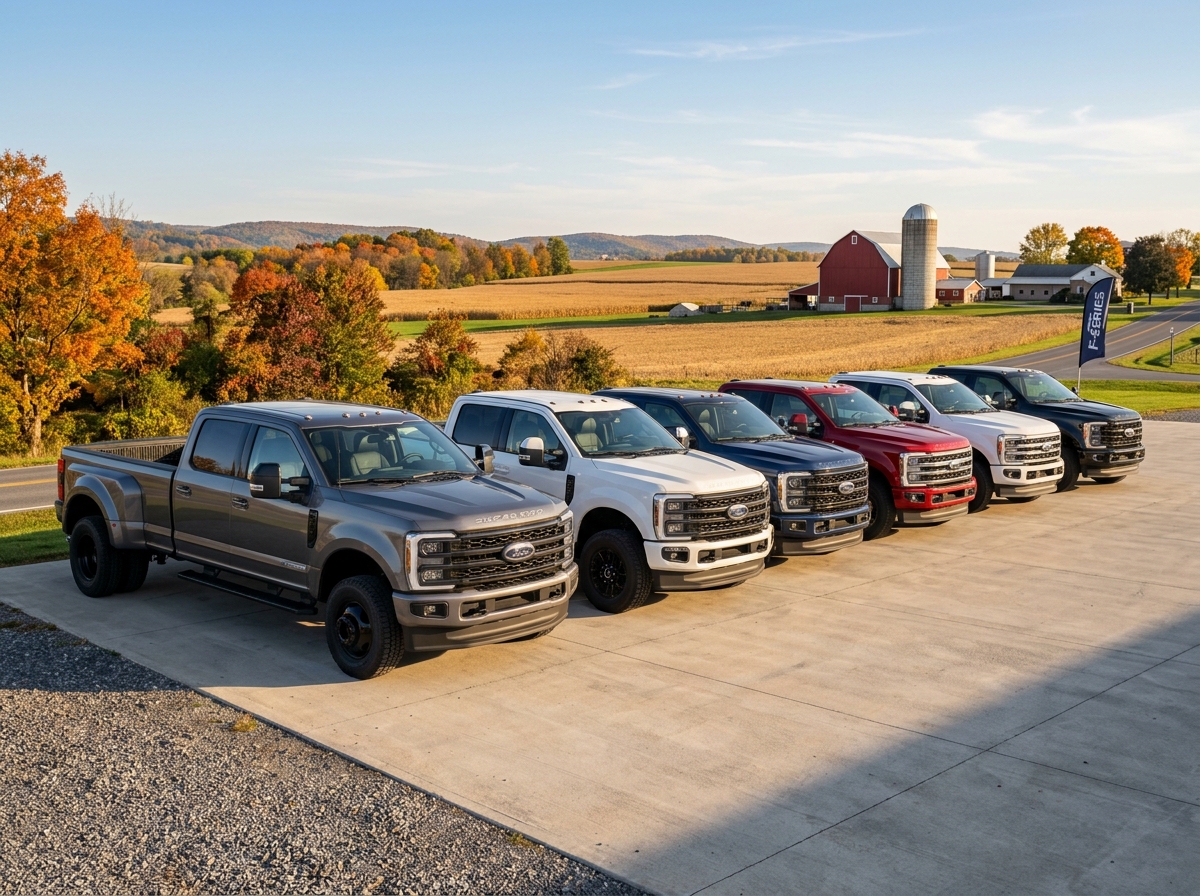
Twin Pine Ford of Hamburg can help agricultural and commercial customers compare F-250, F-350, single-rear-wheel, dual-rear-wheel, gas, standard diesel, and High Output diesel configurations.
Visit us at 301 S Front Street, Hamburg, PA 19526, serving customers from Reading, Pottsville, Kutztown, Leesport, Shoemakersville, Schuylkill Haven, Fleetwood, and surrounding Pennsylvania communities.
Call sales at (610) 929-3683, contact the dealership online, or get directions to Twin Pine Ford of Hamburg.
1 Price, 0 Doc Fees—where quality and affordability meet.
Vehicle specifications, ratings, features, and availability were considered accurate when this article was prepared but may change. Maximum towing and payload ratings require specific configurations and proper equipment. Never exceed the vehicle, tire, axle, hitch, or trailer ratings. Driver-assistance features do not replace attentive driving. Registration and tax information is general educational information and is not legal, registration, accounting, or tax advice. Consult PennDOT and a qualified tax professional regarding your situation.